
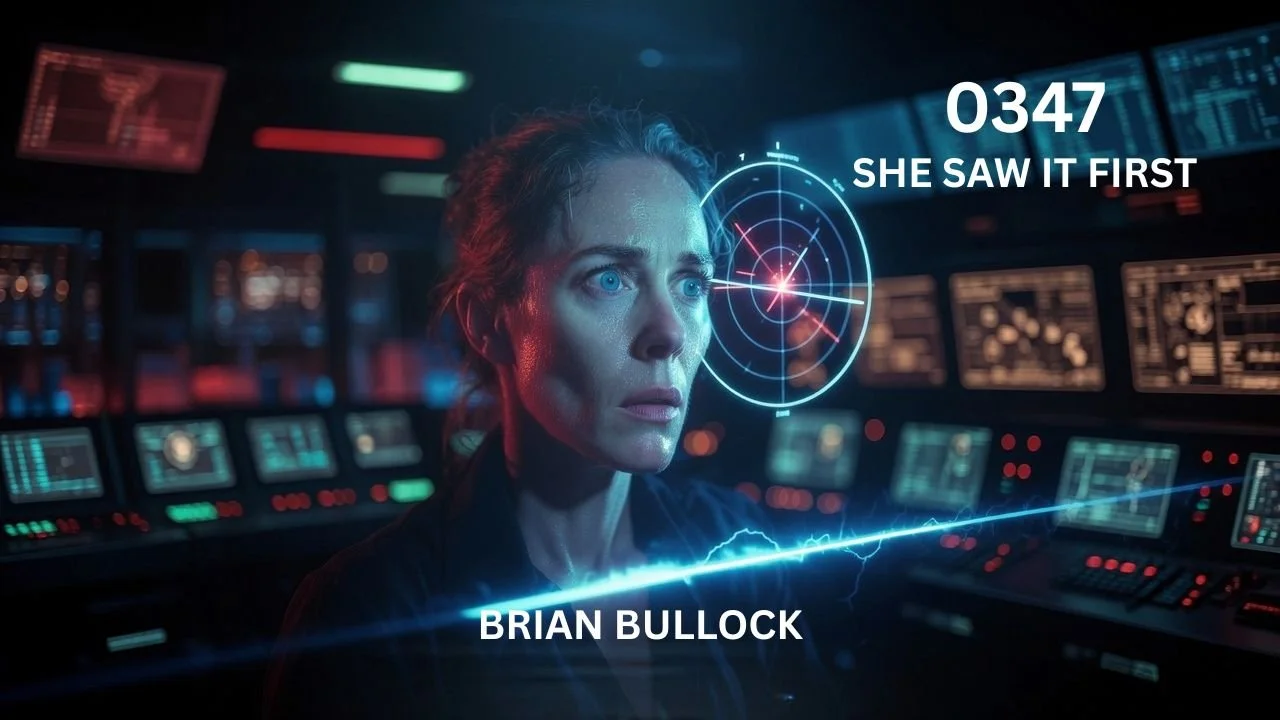
0347
"You want coffee?" Ramirez said. "I'm going up."
He stood up out of the chair two seats down and stretched both arms over his head, until something in his back popped. He was three weeks in. He still looked at the clock on the wall like it was going to tell him something worth knowing.
"I'm good," Rachel said. She didn't look over. She had her eyes on the board and one boot hooked up under the lip of the console, and she was rocking the chair a couple inches back and forth on that boot.
"You're always good."
"Somebody's got to be," she said, and kept her eyes on the board.
He picked his badge up off the desk and turned to go, and that was when she caught it.
It came in on the far-left edge of her screen, way out in the corner, down in the part of the board that catches junk all night long. Radar picks up more than airplanes. It picks up flocks of birds, and rain coming over the mountains, and the ground itself bouncing the signal back, and all that garbage piles up along the edges as little flickers that mean nothing. The computer is built to look at those flickers, decide they're trash, and wipe them off the screen before a person ever has to deal with them. It wipes hundreds of them a night. This one had been already wiped. There was just the little gray note it leaves behind, the one that says the software looked at a return, decided it was nothing, and cleared it.
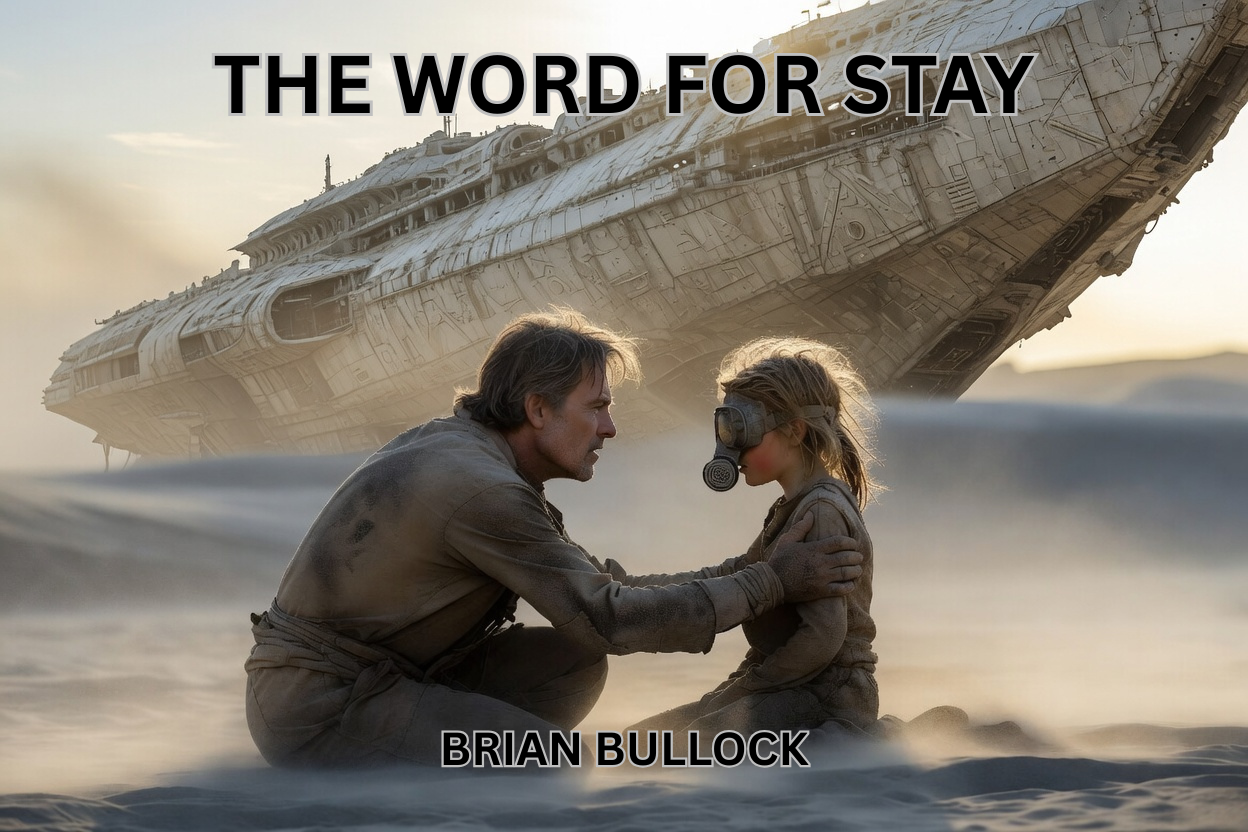
The Word for Stay
By Brian Bullock. A Starborne Studios Production.
Cole Renner had spent eleven years hauling cargo across Harran's world, long enough to read its dust the way other men read weather.
The dust never stopped falling here. It came down fine and gray and slow and buried everything in the end. He read it now from the cab of the crawler, one scarred hand loose on the yoke, the other shading his eyes against the haze. The dunes ran gray to the horizon in long slow waves, and the wind lifted veils of it that hung and turned and settled, and somewhere out in all that nothing was the claim he had paid three years of hauling to register, a square of dust that looked like every other square of it and was his.
"You're squinting again," Tess said.
"I'm working."
"You squint when you don't know where you are."
Renner looked over at her. She was nine, maybe ten, nobody including Tess was sure, and she sat in the jump seat with her boots not reaching the floor and a filter mask pushed up on her forehead and the certainty of a child who had never once been wrong about him. He had found her two seasons back working a slag line, for a man who fed her with what the line spat out, and he had not set out to take on a mouth he could not feed, but he had taken her on anyway.
"I know where I am," he said.
"Then why are we stopped."
He was stopped because the ground was different. Eleven years in the dust taught a man to feel the crawler through the seat of his pants, and a hundred meters back the ride had changed, a hardness coming up under the dunes. Renner had learned a long time ago to listen when the ground changed its rhythm and tune.
"Eat your paste," he told her. "I'm going to walk it."
He went down into the haze with a probe rod and his hood sealed and the wind pushing at him, and he walked the line where the ride had changed, sinking the rod every few steps. Dust, dust, dust, and then, at the ninth try, not dust. The rod stopped a meter down on something that did not give. He worked it sideways. The hardness kept going. He moved twenty meters and sank it again and it stopped again at the same depth, and he stood in the blowing gray with the rod in his fist and his chest went tight. Hardness that ran level under the dunes was not rock. Rock did not run level. Only something manmade sat level, and this was big, under a lot of dust. You hear rumors about things like this, but you never really think they're real.
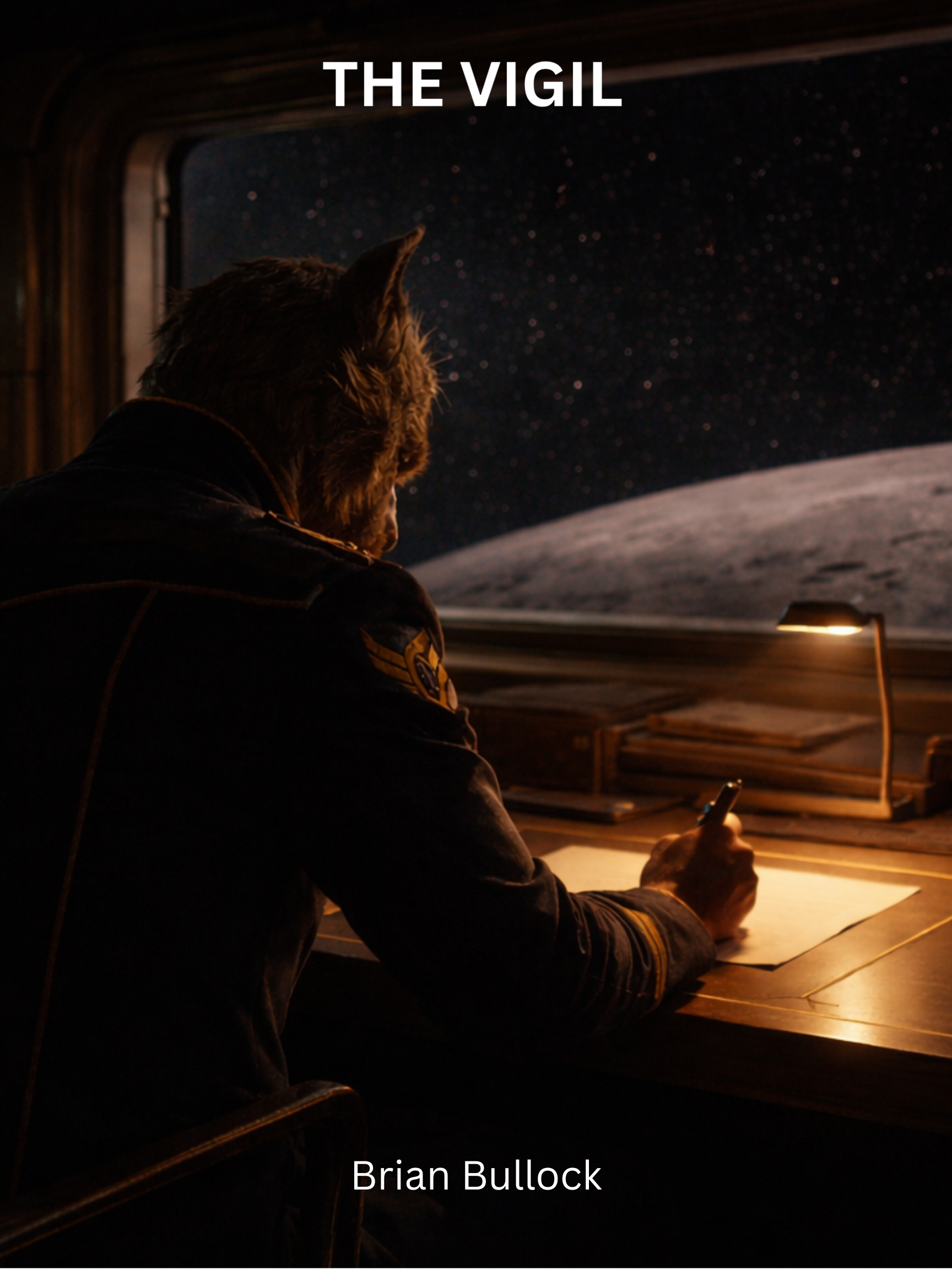
The Vigil
This story takes place on the last night before Daedalus went to sleep.
It is the story of the last man awake, and what he wrote before he closed his eyes.
Chapter One: The Last Duty
The station had never been this quiet.
Oran sat at his desk in the commander's office and listened to it — the unfamiliar stillness of Daedalus without people in it. Not silence exactly, but the absence of the frequencies people produced simply by existing. Footsteps. Voices. The low hum of thousands of bodies going about the business of being alive. He had commanded this station for eleven years and had never once stopped to notice how much of its texture came from the people inside it. He noticed now.
Three thousand and forty-one people were sleeping in the stasis bay.
He had walked through it one last time before coming here — not to check the systems, but simply to be there once more in the blue light. To see the faces of people he had commanded and argued with and eaten meals beside, all of them still now, trusting without knowing they were trusting that the systems would hold and something on the other side of the sleep would be worth waking into. He had moved through the rows without touching anything, reading names on pods he had approved and authorized and filed paperwork for, and when he reached the end of the last row he had stood there for a while before walking back to the office.
He had come to this station as a junior administrator twenty-two years ago and had never left. He had been offered other postings and had declined them all. He had found the place that fit him and had not seen the point of leaving it.
What no one knew was that he came to the arboretum on the nights he couldn't sleep — a small room on the tertiary ring, officially a botanical research station, used by almost no one. On the nights when command sat too heavily he would go there and stand among the growing things and let the smell of soil and green do what it reliably did. He could not have explained why it helped. It simply did. Someone had been tending the plants for years — he didn't know who and had decided not to ask, because the not-knowing was part of what he liked about it. Someone cared about the plants. The plants were cared for.
He had gone there last night. Had stood for a long time with his hands at his sides and breathed the green air and said goodbye without saying anything at all.
The plague had killed one hundred and fourteen people in eight months. He wrote that number at the top of the log and looked at it for a moment. One hundred and fourteen. He had known every one of them — by name and by record and by the way commanders know the people under their command, which is different from friendship but not entirely separate from it.
He wrote the formal opening of the log.
Station Daedalus. Final pre-suspension log. Commander Oran, commanding officer. Current date: the four hundred and twelfth day of the outbreak. Station population entering full stasis suspension: 3,041. Total personnel: 3,042. All essential systems confirmed operational. The station is prepared to sustain the suspension for the estimated duration.
He stopped.
For the estimated duration. He had written it with the automatic precision of a person who had written it a hundred times, and it was accurate in every formal sense and dishonest in every way that mattered. There was no estimated duration. They were going to sleep and they did not know when they would wake and the form had that field because it had been designed for scheduled suspensions of known length, not for this.
He drew a line through the last sentence. He had never drawn a line through anything in an official log in thirty years. He looked at the line for a moment — the clean cancellation sitting across his own careful handwriting — and felt the eight months of formal distance finally give way.
He picked up the stylus again and wrote below the line: There is no estimated duration. I do not know how long we will sleep. I do not know if the plague will be gone when we wake. I do not know if we will wake. What I know is that the station is prepared, and everyone I could protect is protected. That is what I can say honestly. Everything else is hope.
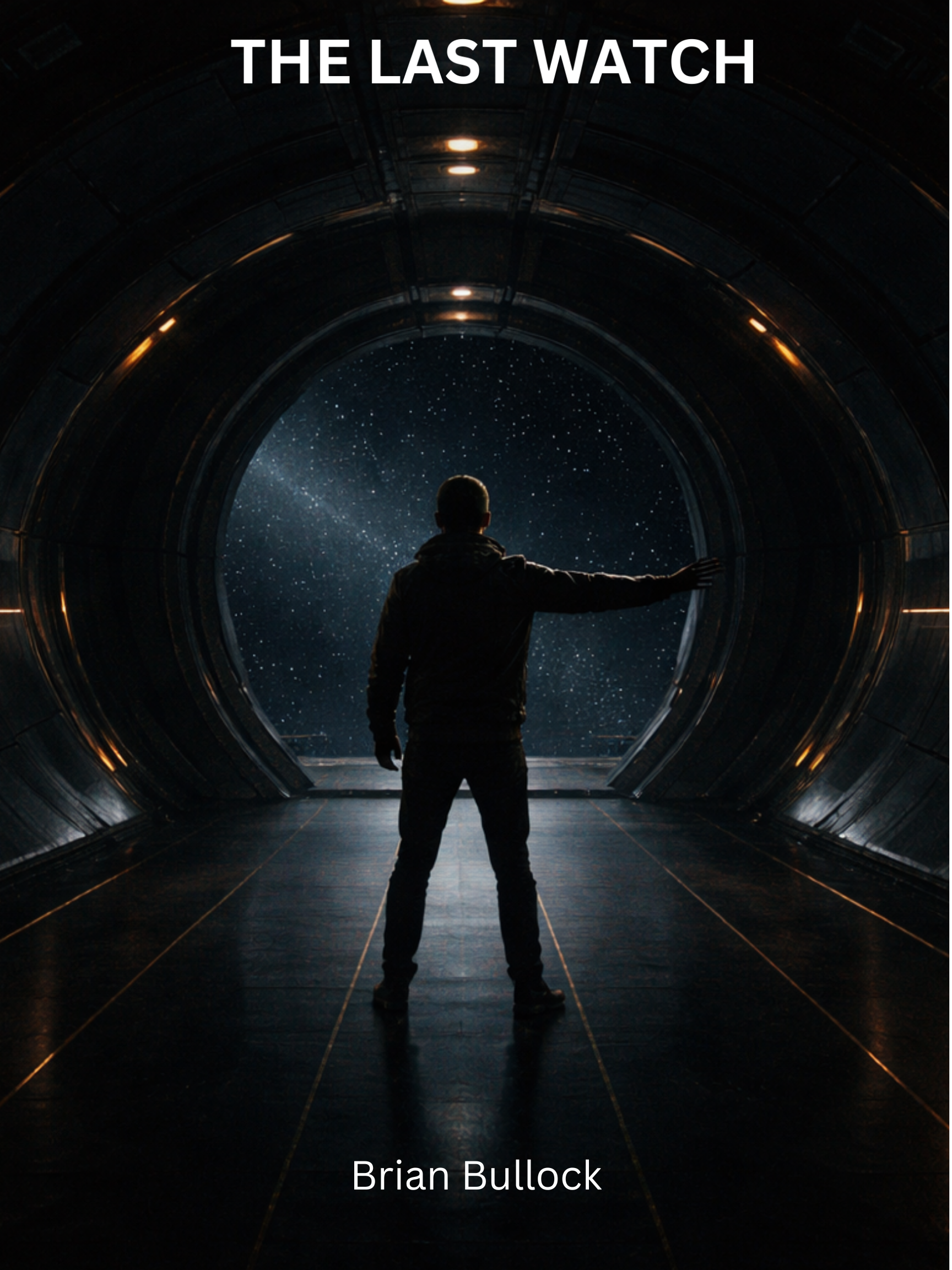
The Last Watch
This story takes place long before the events of The Sentinel Trilogy. It is the story of one man, one station, and forty-one years of keeping the lights on.
The station had a smell. Ren had never thought about it before — the way you stop noticing the air when it has always been the same air — but on the morning of the leaving he noticed it for the first time. Something mineral and warm, recycled atmosphere that had passed through Ketheri lungs for generations. The soft gold light of the corridor lines tracing their familiar paths along the floor. The sound the hull made in the deep hours, ticking and settling in the cold of space, a sound so woven into his sleep that he could not imagine silence without it.
He was thirty-four years old. He had been born on this station. He had never spent more than a few weeks anywhere else. He stood in the corridor outside the stasis bay and tried to memorize all of it at once.
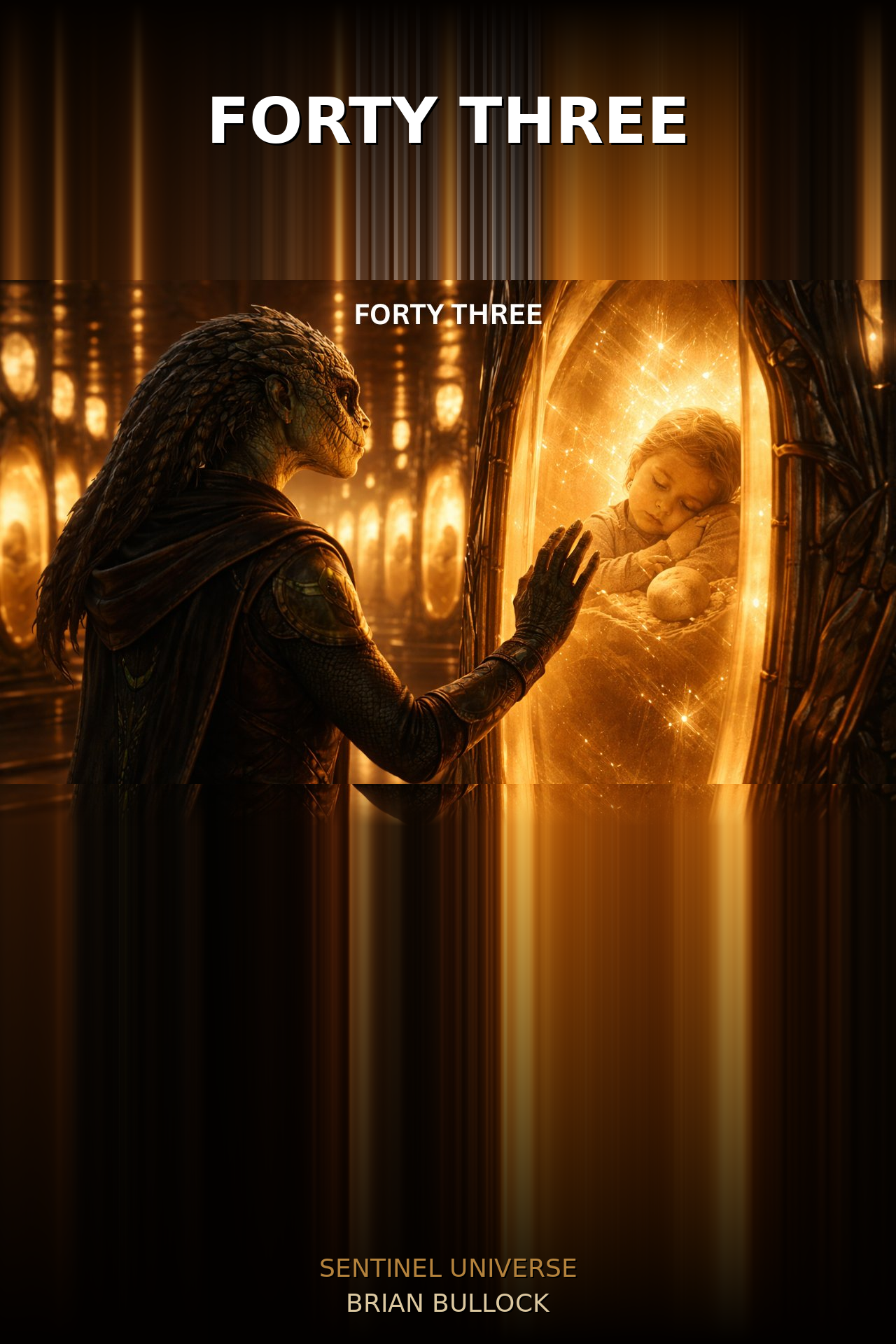
Forty Three
Dareth ran.
Thessara had not always been burning. That was the thought she could not quite release as she ran.
The city had been alive that morning. She had watched Talli chase a neighbor's harvesting bird across the courtyard, arms windmilling, laughing. She had stopped at the vendor on Vessel Street on the way home — the same corner for twenty-two years, he knew her name and always tucked an extra piece of sweetfruit in the bag for Talli without being asked. She had come home to their small apartment in the builders' district and spread her project drawings across the table — the expansion of the eastern reservoir housing, her best commission in three years — while Talli arranged colored stones on the floor, working with the quiet seriousness of someone whose task only she understood, moving pieces and rearranging until something was finally right.
That had been this afternoon. The vendor was still on his corner when the silence fell.
Talli weighed almost nothing. That was the thought Dareth kept circling back to as she pushed through smoke that tasted like melted stone, her daughter pressed against her chest, arms locked tight, face buried against her neck. Her daughter was four years old and weighed almost nothing, and the fragility of that — the specific lightness of her — was the sharpest fear in a night that was full of them.
"Mama. It's loud."
"I know, little one. Keep your eyes closed."
The sky was wrong. Something moved across it like a stain spreading through water — vast and patient, and where it touched, things stopped being what they were. The first district had gone silent three hours ago. No explosion. No warning. Just silence, where thousands of voices had been. Dareth had picked up her daughter and started running before she understood why.
She didn't know why she ran north. She had no family there, no destination that logic could explain. But something pulled at her — had been pulling since the silence fell, maybe longer, maybe her entire life — and it said north, as a certainty older than language, carried in the structure of what she was and dormant until this moment, waiting for the night when everything else failed.
She passed the school on Loran Way. Six years ago she had helped build it — mixed the grout for the foundation herself, hands in the wet material, feeling the structure take shape. Through intact glass she could see the rows of small seats still in their afternoon arrangement. She looked away and kept running.
So she followed it through streets that buckled and split, past buildings that sagged inward as if the will holding them upright had departed, through smoke that carried the smell of things that should not burn.
"Mama, where are we going?"
"Somewhere safe. I'll know when we get there."
A sound rose behind them — not an explosion, not a scream, something worse. A low, vibrating hum she felt in her chest, the sound of matter being reduced to something simpler, something the stain in the sky could digest. Getting closer.
"Don't listen to it," she told Talli. "Tell me the story about Dalla and the river."
Talli's voice came small and steady against Dareth's neck, reciting the children's tale her grandmother had taught her — the same grandmother who had named the stars for her when she was Talli's age, who was in the first district when the silence fell, who Dareth would not think about now. Not while her legs still worked and the pull still pointed north and her daughter still breathed.
The story was simple. A traveler lost in darkness, following a river that only appeared when you stopped trying to see it. Trust the current, it said. Even when you can't see where it goes.

THE BECOMING
Sorath had stopped counting years somewhere around his four hundredth. He was the oldest living Ketheri, and had been for longer than most of his people had been alive. At some point the number became less informative than the fact.
He walked the upper observation level of the research station every morning before the light-cycle shifted. This morning he stood at the viewport and looked at the stars for a long time. And he thought about the people he was leaving.
Essa had died two hundred and eleven years ago. A biologist — careful, precise — who had found his obsessiveness more interesting than exhausting for much of their life together, and then had found it simply exhausting. They had not separated with anger. They had separated with the quiet understanding of two people who had tried to occupy the same life and found that one of them kept leaving it for somewhere else inside his own head.
She had raised their son Soel largely without him. Sorath had shown up for the milestones. His body had been in the chair. He was not sure, looking back across two centuries, how much of himself he had actually brought to any of it.
Soel had died eighty-three years ago. His grandchildren had been polite at the memorial — the specific politeness reserved for someone they had been told to respect without being given a reason to.
He had a great-granddaughter named Teva. She had sent him a message three years ago asking to meet. He had read it four times. He had not answered it.
Standing at the viewport, he held the knowledge of this without looking away. He had made that choice. He had made many choices like it, and they had accumulated into the shape of a man who had done extraordinary work and had not been, in the ways that required presence and patience, particularly extraordinary at anything else.
He asked himself whether he actually wanted to do what he was about to do. The real question, not the prepared answer.
What he found was complicated. The yes was there — forty years of work, two centuries of watching the Vorai patterns grow closer in the data. And underneath that, something older: you are about to stop being yourself. You are calling it a transition because transition is easier to say than ending.
He stood with the discomfort. He did not resolve it. He turned away from the viewport and continued his walk.

THE FIRST
Asha had been loading cargo when the ship responded to her.
There was no light, no sound, no sensation she could have described to anyone in a way that would have made sense. One moment she was working — moving sealed containers from the dock transport to the lower bay, doing the job she had been doing for three years — and the next moment something was present in the back of her awareness that had not been present before. Just a quality of attention, aimed at her from somewhere nearby, something that had been searching for a long time and had just found what it was looking for.
She looked at the Ketheri ship docked at bay four. She had worked around Ketheri ships her entire adult life and had never given this one particular attention. It was giving her particular attention now.
She finished her shift, went home, went to bed, and told herself it was the kind of thing that happened when you were tired. The next morning the feeling was stronger. She changed her route to work. She stayed late two nights running. On the third morning she took the route past bay four anyway, because she had spent thirty-one years making decisions by facing them rather than by looking the other direction.
The Ketheri liaison found her three days later.
"The ship has indicated a preference," he said.
"I do not know what that means," she said.
"The ship at bay four has been observing the personnel on this station. When a ship of its kind identifies a person compatible with a specific role, it signals. We have been attempting to establish a bond between that ship and a person for a long time, and that bond has not held with anyone we selected. The ship selects differently than we do."
"And it selected me."
"Yes."
"I am a cargo handler. I am not a pilot. I am not a soldier."
"The ship does not explain its preferences. It indicates them. We follow them. That is how this has always worked."
"What is the bond? What does it actually do?"
"It connects you. The ship's systems and your awareness become linked. You perceive what it perceives. You operate together. The connection has been attempted before and has not held. We do not fully understand why. The ship chooses differently than we do."
"What happens if I say no?"
"You can say no. But the ship will wait. And it will keep indicating its preference until the preference is honored or until the circumstances no longer permit waiting."
She thought about it for a week. She walked to bay four on her lunch break and stood at the viewport looking at the ship. The feeling was there every time — steady, patient, not demanding anything from her, just present. On the fifth day she sent Serath three questions. Her position would be held. Her choice at every step. No one else knew. On the seventh day she said yes, because the feeling had not diminished and she had never been the kind of person who made decisions by refusing to make them. She did not fully know what she was saying yes to. She knew only that something was asking and she had run out of reasons to keep not answering.
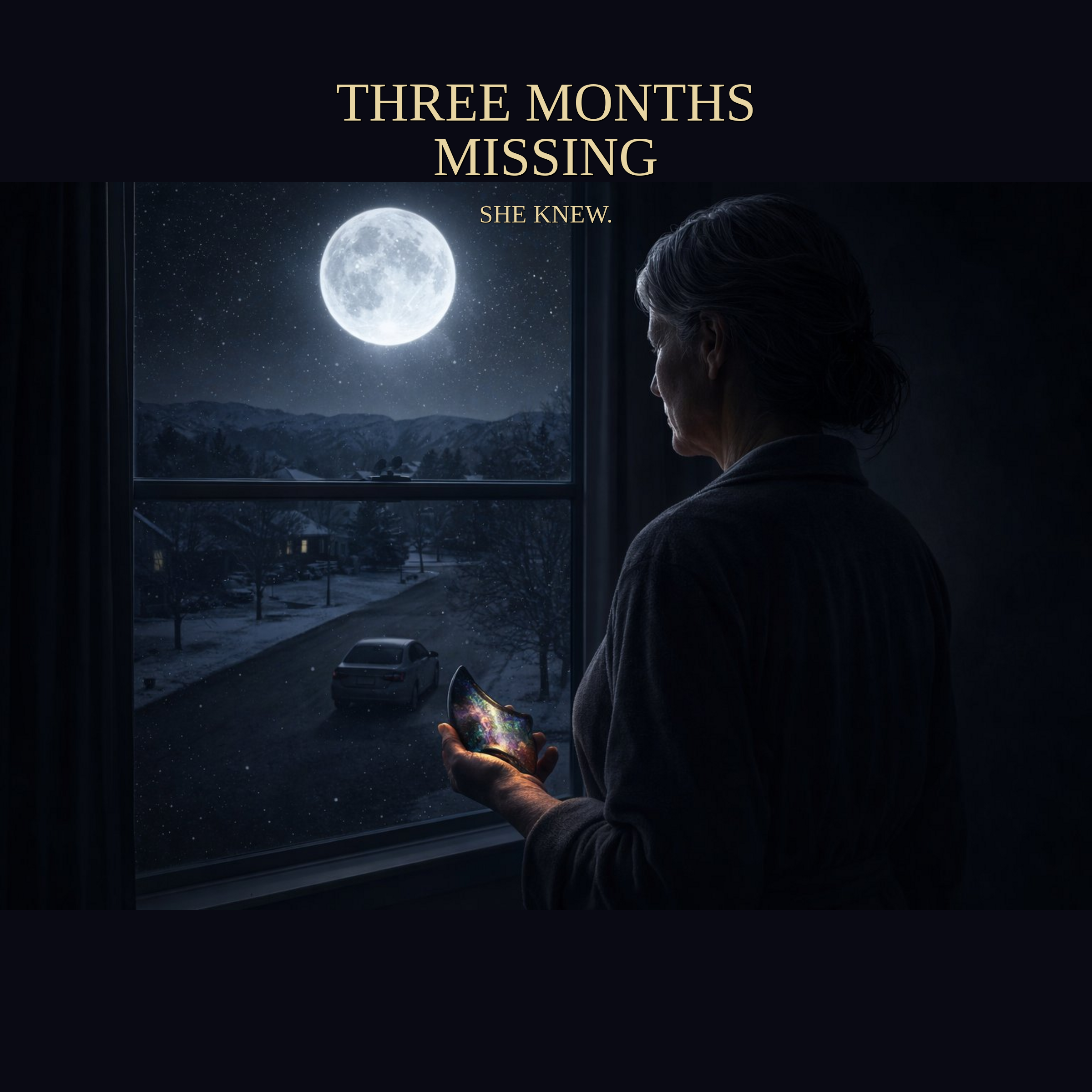
THREE MONTHS MISSING
Barbara Matthews hadn't slept through the night since September.
She'd tried everything — warm milk, herbal tea, the sleeping pills her doctor prescribed that made her feel like she was walking through chest-deep water. Nothing worked. Every night around two in the morning she'd wake with a start, heart loud in the dark, reaching for her phone to check for messages that never came.
Three months. Ninety-two days since Bron had called to say he was going camping. Ninety-two days since she'd heard his voice, heard him say Love you, Mom the way he always did at the end of their conversations — casual, almost embarrassed, but always there. He'd never once missed it. Not since he was seventeen and had started saying it without being asked.
She had always thought of herself as a practical woman. Rancher's daughter, rancher's wife for twenty-two years, mother of two sons she'd largely raised alone after Frank left — not because she'd failed at anything but because Frank had been the kind of man whose restlessness eventually outran his commitments, and she'd made peace with that years ago. She did not catastrophize. She did not borrow trouble. She had the Montana disposition toward silence and forward motion that came from growing up in a place where the winter was long and the land was hard and you did what needed doing without spending too much time on how you felt about it.
Ninety-two days had tested that disposition to its foundation.
Ninety-two days of nothing.
She sat at the kitchen table now, a cold cup of coffee in front of her, watching the December light push through the curtains. The house felt wrong in a way it hadn't even after Frank left. Frank's absence had been a different kind of wound — sharp and clean, the kind you could name and eventually learn to carry. His chair at the table still felt like his chair, but it was a memory, a closed thing. This was different. This was waiting. Not knowing. The specific cruelty of a silence that might mean anything — and every morning she woke and reached for her phone and the silence was still there, unchanged, ninety-one days becoming ninety-two becoming ninety-three, and she got up and made coffee and kept going because that was what you did, even when the going felt like walking through a house where every room had something missing and you couldn't stop noticing.
Her phone buzzed. Derek.
Call me when you're up. Found something.
Barbara dialed before she could think.
"Derek? What is it? Did you find—"
"Mom. Breathe." Her older son's voice was steady, the way it always was in a crisis — he'd gotten that from his father, the ability to go still when everything else was falling apart. "I didn't find Bron. But I found something. I'm coming over."
"What kind of something?"
A pause. The careful kind.
"Something that doesn't make sense. Thirty minutes."

THE SHERIFF'S LAST REPORT
Sheriff Arden Calloway sat in her office at 11:47 p.m., staring at a file she was supposed to have closed six weeks ago.
The coffee had gone cold hours ago. The heating system ticked and groaned the way it always did in December. Outside her window, Main Street Choteau was empty, the Christmas lights on the storefronts throwing multicolored reflections on the frozen puddles. She should be home. Her husband had stopped asking why she came home late because he already knew the answer.
The Matthews case.
She'd been a cop for twenty-seven years and she had never failed to close a case in her head. That was the thing people didn't understand about the work — the paperwork closed, the jurisdiction transferred, the file handed to whoever had the authority to take it from you, but the case in your head closed separately, on its own timeline, and it closed when you had an answer. An ending. Something that fit the category of things you already understood about the ways human beings came to grief.
Bron Matthews hadn't given her an answer. The federal agents who had taken her case hadn't given her an answer. They'd given her a national security directive and a flat voice and the particular indifference of people who had already decided that she didn't need to know.
So the case stayed open. In her head, where no one could close it for her.
For six weeks she'd been coming in after dinner, after Martin went to bed, and sitting here in the ticking quiet of the department building and going through the photographs she shouldn't still have. Trying to find the thing she'd missed. The thing that would make it fit somewhere, anywhere, in the twenty-seven years of categories she'd built for human disappearance.
She'd been finding nothing. Until tonight.

THE TRUCK
The radio crackled with static before Calvin Rourke could respond to dispatch.
"Rourke, you copy? Got a report of an abandoned vehicle up on Service Road 12. Forest access area, mile marker 8."
Calvin shifted in his seat and reached for the mic. Twenty-three years with Montana Fish, Wildlife and Parks, and abandoned vehicles still made up half his calls. Hunters who'd had too much to drink. Hikers who'd underestimated the terrain. Kids from Choteau looking for somewhere private to be stupid.
"Copy that, dispatch. En route. ETA forty minutes."
The October sun hung low over the mountains, painting the peaks in shades of copper and rust. Beautiful country. Dangerous country, if you didn't respect it. Calvin had pulled enough bodies out of these woods to know that the Rockies didn't care how pretty they looked while they killed you.
He'd grown up twenty miles from here. His father had brought him into these mountains at eight years old with a .22 and a patience for sitting still that most boys that age didn't have, and Calvin had been one of them — too restless, too full of motion — but the mountains had fixed that. The mountains had a way of teaching patience to people who thought they didn't need it. You learned to sit quiet in them, or you learned to go home.
Calvin had stayed. Twenty years in the Army had taken him to places that needed no naming — dusty, loud, broken places where nothing was as old as the mountains here — and every deployment he'd thought about the quiet. About the pines and the particular way the October light hit the peaks in late afternoon. About coming back.
He'd come back. Margaret had been waiting, which was more than he'd deserved, and they'd built a life in a house on the edge of the forest service road that he now drove every day with the quiet satisfaction of a man who had found his place and intended to stay in it.
The satisfaction was not simple. After twenty years of Army, nothing was simple anymore. But it was real — the steady, low-key pleasure of a man doing work he understood in a place that made sense to him. He knew these mountains. He knew their moods, their dangers, the ways they tried to kill you and the ways they didn't, the difference between a forest that was fine and a forest that was about to become a problem. After Iraq, after all the places that had been loud and broken and incomprehensible, the legibility of these mountains had been a gift he hadn't known how to receive until he'd been home long enough to stop waiting for something to go wrong.
Abandoned vehicles. Missing hikers. Poachers. Fires. The ordinary catalog of problems that a man could handle with the skills and the tools he had.
He turned onto Service Road 12 and began the slow climb through the pines, and for the last time in his life, he thought he knew what the mountains could throw at him.